Weekend Wanderings: Green Island

DSC_1082

Photo by author

Taiwan does a good job of providing an abundance of places for quick weekend excursions and with the heat and humidity beginning to set in on Kaohsiung, we recently jumped at the opportunity to join some friends on a trip to Taiwan’s Green Island.

The small speck of an island, located about 19 miles east of Taitung in southern Taiwan, is a popular diving and resort destination for those within the country, but is rarely mentioned as a “must visit” among other travelers in the region. It would be a rare sight, for example, to see a hoard of Aussie backpackers slamming beers on the ferry deck in route to Green Island’s Nanliao harbor.

Still when our group of five showed up there were plenty of Taiwanese tour groups moving about in scooter herds and crowding the souvenir shops.

For us, the trip brought welcomed respite from the Kaohsiung smog and an opportunity to see some more of Taiwan’s fabled coastline. The island itself–a stunning mixture of lush vegetation, crushed coral beaches and jagged volcanic mountains–seems much to0 pristine of a setting to have ever been home to a brutal political prison.

We planned to grab a few scooters as our transport for the weekend, but a recent fatal crash involving two foreigners on the island prompted scooter rental companies to change their policy, renting only to those with Taiwanese drivers licences–frustrating, but understandable.

Instead we settled on the option of bicycles. Sadly I was quite disappointed with the quality of the rides we were given. Had they been bicycles properly suited for the terrain, circumnavigating the island–and all her seaside cliffs–would’ve been a welcomed challenge. Instead I found myself dreading the trips we made from our campsite into town and back again, pretty much ensuring that an attempt at cycling around the island would not be made (big shout-out to Nomad Notions author Jenna Longoria and her boyfriend Dominic for accepting the challenge and succeeding).

We were able to set up camp on the southern tip of the island, on a bluff just above the island’s famous hot springs, about 100 yards from a scenic lookout post. I’m not entirely sure if camping here is even permissible, but the official camping grounds were closed due to renovation and the small herd of goats grazing nearby weren’t noticeably bothered so we claimed it as our own for the night, taking taking note of the goat shit scattered around the site.

Among all the things to do in Green Island, I was probably most interested in visiting the Zhahori salt water hot springs–one of only three in the world.

There’s five or six pools that range from chilled to steamy and you can grab a basket to put your belongings in while you take a dip. We changed in our tents, but there’s locker rooms with showers on the premises as well.

As is the norm we attracted a few stares but many others couldn’t have cared less about about our presence. Before we could take the plunge, however, we were quickly informed that we would need to wear swimming caps if we wanted to enter the main pools. Should we not want to wear  swimming caps, we would only be able to sit in the pools closer to the beach. The only noticeable difference besides the location was that the two pools near the beach were essentially dead coral tide pools ringed with cement barriers that have the warm spring water piped-in. Fair enough.

None of us were in the mood to purchase a swimming cap so we headed towards the beach and joined two Taiwanese guys already there. The water wasn’t as hot as I wanted but still relaxing and whereas were were told we couldn’t have beverages at the pools requiring swimming caps; here we’re able to knock down a couple of beers in peace–at least until one of the attendants began glaring at us and grabbed his walkie-talkie. I have no idea what he said to the person on the other end, but we clearly heard him mention “weiguoren” (foreigner). The jig was up.

We returned to the the other pools and wrapped our heads with towels and sarongs, satisfying the swimming cap rule. The sight–I’m sure–did little to combat the “crazy foreigner” stereotype (Kay looked like the Chiquita Banana lady) but none of us cared as we were finally allowed to enter the other pools. I went for hottest available and followed the example set buy an elderly Taiwanese woman–lapping water onto my neck and shoulders. I somehow felt this was the more therapeutic way to enjoy the hot spring. I added to the strategy by sipping wine out of a paper cup every so often. I would go on to try out all but the coldest of the springs before rain sent us scurrying back to the tents.

It should be mentioned that there’s nowhere near the hot springs where one can easily take a swim in the ocean. Nearby Dabaisha beach is one of main spots for snorkeling and diving, but is also ill suited to take a dip due to dead coral. From the road I could see a few people swimming off a small strip of beach just south of Nanliao village, but never went down to explore further. I’ve also read that the eastern side of the island has beaches where one can easily access the water.

In terms of eating, there seemed to be plenty of places in Nanliao village, near the harbor, but on our visit there were a lot of people who were contently eating at 7-11. We took the recommendation of another visitor and ate at a restaurant on the main strip. Among other things on the menu they offered rice and noodle dishes with venison (deer meat). So far as I know there’s not many many places to try venison in Taiwan so we decided to give it a go. A plate of the venison with noodles, some sashimi and a bit of sautéed cabbage did us well and was cheap enough that I could’ve ordered another dish and not felt guilty.

On a return trip to Green Island I think I’d prefer to have a scooter to throughly explore the whole of it, but I still enjoyed taking in the views and soaking in the hot springs. Our small second-hand tent did well to combat the light rain, but suffered two broken tent poles from battling the wind. Rain on the last day left us soggy on the ferry ride back to Taitung, but the weather more or less cooperated other than that. I won’t count it as a complete success being that we were limited in what we were able to do, but it held it’s own in terms of a quick weekend getaway.

Enough said.

*You can get to Green Island via Taitung. From Kaohsiung it takes about 3 hours by train, after which you will need to make your way to Fukang Harbor (easiest by taxi NT 150-200) and hop the 50 min ferry to the island (between NT 800-900 round-trip).

*Update: a taxi ride from Taitung station will be closer to NT 300-350. I previously posted the price at NT 150-200.

If you decide to camp at the designated campground it will run you NT 400 a person.

Entrance to the hot springs is NT 200 plus the cost of a swimming cap, should you decide to buy one. Avoid the crowds by going during the early morning or doing the day.

Rental scooters can be had for NT 300-400 per day, but you’ll need a Taiwanese scooter license. Should you choose to rent bicycles (not recommended) they’ll set you back NT 150 per day.

Angeles City on a Visa Run

20130420-182730.jpg

ESL teachers know the visa run quite well: you leave the country for a short period of time (sometimes just a few hours) to reset the amount of time your’re allowed to stay on a certain visa. Expats in Korea make a quick sojourn to Japan, folks in Laos head to Thailand and those of us in Taiwan usually head to Hong Kong.

In most cases you can simply leave and come right back, but sometimes you might also need to visit an office, fill out forms, submit passport photos, wait in line and do a secret handshake with a certain official who is only available from 1 pm to 3 pmand pay an expensive fee before they let you back in.

My run wouldn’t involve jumping through said hoops, but I would still need to leave the country and return to allow enough time for my work permit and Alien Registration Card to be processed without overstaying my original 90-day landing visa. Confusing? Yes. Convenient? Not in the slightest.

Before coming to Taiwan I anticipated the possibility of having to make a visa run in the event that I couldn’t find a job within the first couple of months so I bought a ticket ahead of time hoping I’d never have to use it. Most expats in Taiwan head to nearby Hong Kong, but tickets to the Philippines were significantly cheaper for the dates I needed. I figured I might have a chance to sneak off to the beach before my flight back to Taiwan.

I figured wrong.

I half-assedly look up where I’ll be landing and discover that I’ll be nowhere near a beach. The Air Asia flight from Taipei drops me just outside of Angeles City, the sex entertainment capital of the Philippines. When Clark Air Force Base was still up and running (a few miles west) Angeles City was where U.S. pilots would go for wholesome R&R.

I arrive by bus from the airport and the first image I see is an elderly caucasian fellow with a fanny pack being led down the street by a much shorter, much younger filippino girl. On the walk to my guesthouse I see different versions of the same “couple” several more times.

My first trip to the Philippines and I end up in the red light district.

I make my way to the Villa Santol Lodging House tucked away on a quite street just off the main drag. When I pass through the yellow iron gate I’m greeted first by a group of 7 or 8 elderly casually sipping beers at a table in the open air bar. I say hello, but no one seems to pay me any attention. They’re all speaking in thick Australian accents.

A short round Filippino woman checks me into my room and gives me a couple pointers: I can help myself to beer and other beverages in the cooler so long as I write down what I take; after dark I am to lock the front gate when I leave and I need to stay alert when walking through the neighborhood. I inform her that I will only be staying for one night and request a cold beer.

I grab a seat at the counter and can’t help but listen in on the table of Aussies behind me. One of the guys is telling a story about a friend who was recently overcharged at a bar. None of the others seem to understand because they keep arguing over the details.

“So he had 6 beers but was charged for 7?”
“Was the waitress cute?”
“What kind of beer was it?”

I get the feeling they meet here regularly–an Aussie shriners club or something, only these guys have done away with the maroon felt hats and are wearing t-shirts with the names of bars and strip clubs printed on them in bright neon letters.

They finish their beers and the conversation shifts to their plans for the evening.

“Dancing girls or football tonight, boys?”
“Well you can’t fuck a football, mate!”

I imagine these fellas are the surviving remnants of Full Moon partiers that never gave up partying. The magic mushroom shakes and booze buckets have given way to watching rugby and ordering lap dances. Life must be rough.

They ask about my plans for the night and I tell them I will only be having dinner because I’m heading back to Taiwan the next day.

“Back to the band?” someone asks.
“Uh, not exactly.”
“Oh, I figured you’re in a rap band.”

I’m slightly offended, but also curious as to how he came to the conclusion that I’m a rapper from Taiwan.

They take off and I am left to figure out where to eat dinner. A quick Google search brings me to the Angeles City “Gentleman’s” travel guide (link NSFW). In addition to restaurant listings, they also offer advice on how much to tip local prostitutes. Clearly they aim to be comprehensive.

I settle on a Mexican restaurant within walking distance and am once again told to be aware of my surroundings when walking throught the neighborhood at night.

On the way there I pass places called Honkey Tonks, Shadows and Gobbles Heaven, all with their own cluster of showgirls sitting out front. I get cat-called with phrases like “We love the sexy black man” and “Sexy Bob Marley!” A boy selling cigaretts out of a large wooden box stops me and goes into a rehearsed spiel about Marlboro and other popular brands that can be had for a good price. I decline the offer, but ask where Tequila Reef Cantina is. Frustrated, he mumbles something under his breath before moving to the next passerby.

A motorized tricycle driver (the Filippino version of Tuk-Tuks) points me in the right direction of the restaurant and I deposit myself at the bar and order a margarita. The restaurant is half full with the same lot of older white guys I’ve been seeing around town, along with a few Filipino guys knocking back bottles of San Miguel. It occurs to me that I haven’t seen any young tourists or travelers in Angeles City. With discount airline Air Asia flying in and out of Clark Airport to and from tourist hotspots elsewhere in the Philippines, I halfway expected to see a bustling backpacker ghetto with family run hostels and internet cafes when I arrived. It certainly has the feel of Koh San road or even Vang Vieng but all the twenty somethings in flip flops have been replaced with fifty somethings in tube socks. Instead of cart vendors laden with t-shirts and pad thai, the vendors here hawk condoms and foreign cigaretts. When the sun goes down in Angeles City there are plenty of tourists about, but many of them appear less interested in sand pales filled with vodka and Red Bull and more interested in exotic pleasures.

Back at the restaurant I ask the bartender what’s good on the menu and she steers me away from the Mexican fare.
“I like the bistek tagalog.” I take the suggestion on the thought that during my first visit to a country, the first thing I eat should be something local–plus it’s one of the cheapest items on menu. The bartender–a slim gal named *Sophie who wears her “don’t fuck with me” face as well as any female bartender I know–replaces my empty margarita glass with a bottle of San Miguel and I ask her how she feels about Angeles City being a hot bed for cheap thrills.

“Why? Are you fishing?” I’m thrown off by the question, but quickly comprehend the meaning. I once again explain my visa situation She skeptical–but satisfied–with my response.

“I don’t like it all. I was born and raised right here in A.C. …but I wouldn’t raise kids here.” I assume this is because girls from Angeles City run the risk of ending up working at one of the red light bars, but Sophie tells me that many of the bar girls are from elsewhere in the Philippines–mainly Manilla. Instead of staying in Angeles City, Sophie plans to join her boyfriend in New York once she has saved enough money. I want to ask more, but my food arrives and Sophie gets hit with a wave of drinks.

I finish my food and decide to take the long way back to the guesthouse. Fields Avenue–the epicenter of Angeles City’s gentleman’s district–is just starting to rev up. Distorted club stereos compete with traffic nose and cat calls from the bar girls. Trike drivers offer to take me wherever I want to go, roaming sun-burned tourists stumble in and out of bars, some with drinks still in hand. Most of the shops on Real st. are closed, but a few vendors are stil selling souvenirs and trinkets to anyone willing to stop and take a look.

My flight tomorrow leaves at 12:05.

Angeles City probably won’t make my Top 10 list of day trips, but as visa runs go, I’d imagine it’s as good a place as any. The accommodation is cheap, the beer is good and–unless you’re into strippers and bar girls–you’ll be ready to leave the next day.

A few tips for those making the same visa run:

-Air Asia offers flights between Taoyuan International Airport (TPE) and Clark (CRK, just outside of Angeles City) for as little as $44 USD one-way.

-To get to Angeles City from Clark airport, hop on a Jeepney (half jeep, half bus). They wait for passengers just outside the airpot exit on the right. The cost is 50 Pesos. It won’t leave until it’s full. Get off at the first stop near Jollibee restaurant. To get back to the airport head to the Clark/Freeport Jeepney Terminal just across the street from Jollibee and ask one of the drivers to tell you which gate to wait at for Clark Airport.

-The Villa Santol Lodge is worked out well for a night’s accommodation. It’s about a 10-15 minute walk from the Jeepney terminal, on Fatima and S.Surla. If you book by phone you’ll get a small discount. I paid 490 Pesos for a simple room with a fan and shared bathroom.

-Unless you plan to do some serious partying, you shouldn’t need more that 1,500-2,000 Pesos for a single day visa run. This will be enough to secure a cheap room, grab dinner and breakfast, and get a few beers. Keep in mind that you will also be charged an exit tax at the airport when you leave. If I remember correctly it’s about 450 Pesos.

-Don’t be stupid. There’s a lot of nonsense you can get into if you’re not paying attention. When you go out, don’t bring any more money than you need.

*Author’s Note: Named changed to protect privacy.

K.I.F.F. a “Delicious Success”

DSC_1183

These last few days have been rough.

Not only did I have a severe case of F-U-Mondays, but the recovery from my food bender last weekend has taken longer than originally anticipated.

I’ve never been a shining model of self-restraint–even less so when it comes to food, but all hell breaks loose when you subject me to a smorgasbord of culinary crack like what was found at the Kaohsiung International Food Festival.

Please take a moment to back-hand yourself if you missed it. DSC_1049

I had doubts about the chosen venue, but the Dream Mall worked well, allowing attendees to move though a corridor of food booths before being deposited in front of the main stage or along the side of it pass through and exit the festival altogether.

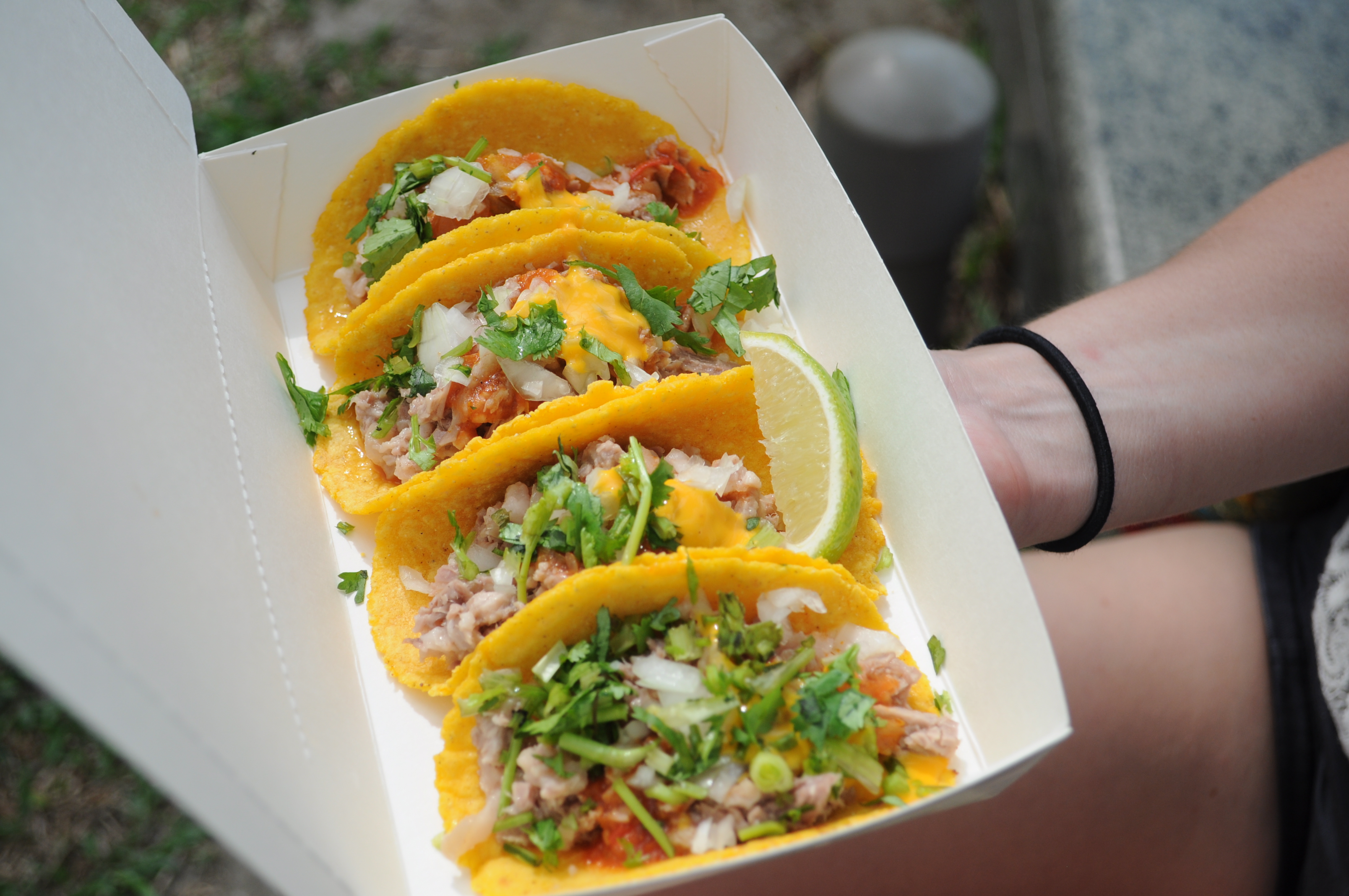
When we arrived Sunday afternoon I quickly went about the business of snacking on all there was to offer–successfully knocking off Taco Rico’s yellow corn soft shell tacos, roasted pork knuckle and sauerkraut from Deutsche Kuche and New Zealand hard cider from Sarkii alcohol importers. I then moved on to The Bayou’s catfish tacos, and a tasty Portugese egg tart compliments of Cafe de Macau. As promised, most of the food was priced to sell so wallet guilt was nil.

Haxstrong founder Greg Haxton

Haxstrong founder Greg Haxton

The Haxtrong charity crew was also out in full force selling raffle tickets, T-shirts, brownies, banana bread and other goodies to help further their much needed cause, and judging by the constant swarm of people around their booth I’d say their efforts didn’t go unnoticed.

Kaohsiung’s reigning burger champ The Eatery was de-throned by Foster Hewitt’s Pub and Grill for Best Burger accolades and The Bayou took the Best Pizza title, but my personal congrats go to the brave folks that entered into the Burger Eating contest.

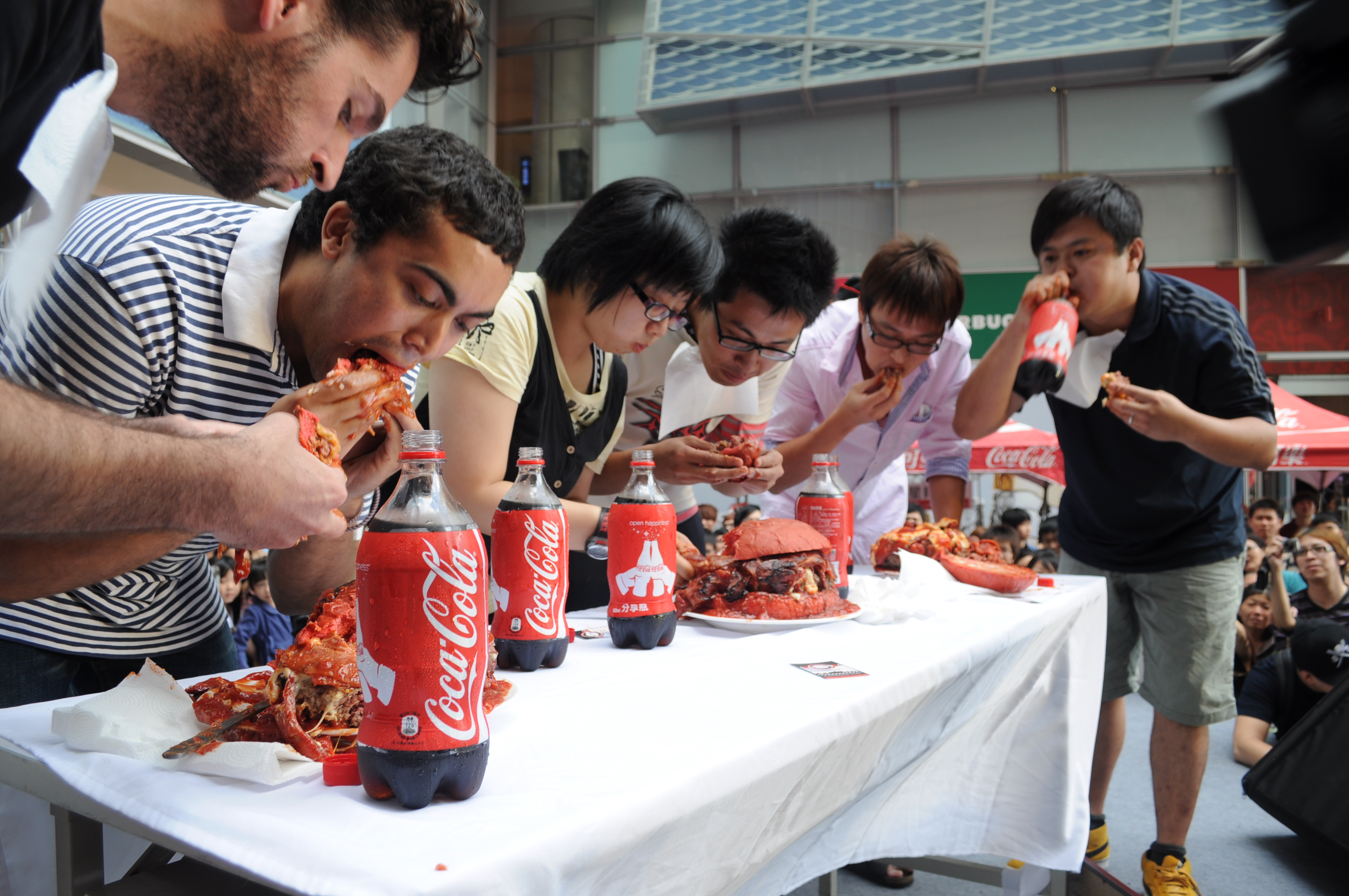
Three 2-person teams spent thirty minutes trying to consume a 6-pound burger appropriately named “The Hulk.”

Why anyone would volunteer for such a task is beyond me as I’m sure there are health risks involved in consuming that much meat in one sitting, but I rather enjoyed being a spectator and snapping photos of a scene that looked like something out of The Walking Dead.

At the 15 minute mark the contestants were looking sluggish and I became increasingly concerned about whether or not I was in range of a potential projectile vomit barrage. The foreigner squad was well ahead of the two Taiwanese teams but I still gleefully cheered on, urging them to take one more bite to honor their respective countries.

KIFF Burger Eating Competition.

KIFF Burger Eating Competition.

When it all ended the stage looked like a lamb slaughter had just taken place and the six lethargic contestants smiled at the crowd with ketchup stained lips. The winners were given a couple gift cards, a plaque commemorating their victory and a liter of Coca-Cola.

Feeling inspired, I headed back over to the food booths to see what was left to sample.

Round two included a bratwurst from Cory’s Kitchen, more hard cider and several spoonfuls of frozen yogurt from Hello Berry. I flirted with a bite size sample of panzerotti at the Lulu John booth, but gave the full sized portion a miss in hopes of saving room for St. Louis style ribs from Blue Smoque BBQ. Sadly I had to throw in the towel. Vetti Vetti Vicci.

The food gave way to music towards the end of the night and those who weren’t too stuffed hung out and did their best to provide the bands with a dance crowd. By then my stomach was too full for me to do anything more that sway and bob my head, but I stuck around to hear K-Town’s much loved Liger Attack.

Kudos to Ryan Parsons and the participating vendors for putting together an event that everyone can boast about. I was pleased to see a healthy mixture of foreigners and local Taiwanese vying for positon in the food lines. Perhaps an added benefit to events like KIFF is that they help illustrate how diverse the foreign community is while dispelling the myth that we’re all a bunch of loud drunkards looking to get laid.

When I asked Ryan about next year’s festival he rattled off his process for figuring our how to make it even better.

One suggestion: cots and pillows for the gastro-inebriated.

This slideshow requires JavaScript.

Peace.

2nd Annual Kaohsiung International Food Festival 3/23-3/24

Image courtesy of the Kaohsiung International Food Festival

I don’t usually need a reason to gorge myself on international cuisine being that I tend to sample any and everything that catches my senses, but this weekend presents a unique exception.

The 2nd annual Kaohsiung International Food Festival kicks-off this Saturday and will offer ample opportunity to stuff your face with foreign goodies from Kaohsiung’s expat chefs. Expect to see less stinky tofu and more smoked ribs and levercase.

Around 30 restaurants and food vendors from 19 different countries will be showcasing their fare throughout the weekend and several will be competing for Best Pizza and Best Burger titles. Festival goers can also flex their skills in several competitions including the Waiguoren Wok Challenge (foreigners cooking Taiwanese food for a panel of Taiwanese judges) and an air guitar competition benefiting local charity, Haxstrong.

Besides the food there will be a DJ ad several local bands on deck to help deal with “The Itis” (AKA food coma) and an MC will floating around interviewing participants and helping to move the event along smoothly.

The festival is being put on by Event Chairman and Kaohsiung veteran Ryan Parsons who was able to field a few questions about this year’s KIFF and the festival’s origins:

DT: How long have you been in Kaohsiung?

RP: On and off since 2000.  I arrived the day Chen Shui-bien got elected and the country was going crazy!  It calmed down the next day but I thought it would be that hysterical all the time. 

DT: What are a few things that you’ve seen change since you arrived?

RP: The city isn’t even close to what is was like in 2000.  The government has (since) funded city projects that have truly made Kaohsiung a city of the future.  The international community was non – existent when I arrived and now we have the largest international food festival on the island that is completely run from top to bottom by the expat community.

DT: How did the idea come about to put together a food festival in Kaohsiung?

RP: When I used to have restaurants what I loved most was sharing my culture’s food with the locals in the same way they get excited about sharing their local cuisine with us (foreigners).  As the international community increased in size so did the restaurants opening to serve them.  Its been a project of mine for 4 years and I’m blessed to have such great foreign restaurants to be able to make it a possibility. 

DT: Can we expect to see Taiwanese food vendors as well?

RP: The Taiwanese have so many unique and fantastic festivals and markets. It’s our turn to serve them and treat them to a weekend of our food, music and culture.  Thank you for making us feel at home, Taiwan!

DT: What’s included in this year’s KIFF that wasn’t a part of the festival last year?

RP: The Waiguoren Wok competition, Kaohsiung’s Best Pizza competition, Latin dancing lessons, (food) demonstration and interactive video tents, A Bourbon Street bar and stage, more food and drink and a wider array of music and activities.

DT: One thing the absolutely MUST be sampled at this year’s KIFF?

RP: With prices starting at $60 NT we’ve made it possible to sample everything, though you may have to come both days.

Ryan graciously dodged plugging any specific vendor on that last one, but I’ll personally be seeking out Deutsche Kuche’s Bavarian roasted pork knuckle, and Mama Africa’s roti.

Keep in mind that this is a green event and everyone is encouraged to bring their own plate and utensils or else borrow them from the KIFF information desk.

The festival takes place at the Kaohsiung Dream Mall (look for the dubious ferris wheel on the roof).
Sat. 3/23 12 pm-9 pm
Sun. 3/24 12 pm-7 pm

Be sure to check out the KIFF website for updates, full menu and entertainment listings and vendor & sponsor info.

Peace.


Insta-Blurb: 5 Tips for Scooter Parking in Taiwan

20130312-000711.jpg

Of all the vehicles on the road in Taiwan none is more ubiquitous than the scooter. They’re everywhere, zipping up and down streets and sidewalks alike, sometimes carrying whole families, several puppies, groceries–all at the same time.

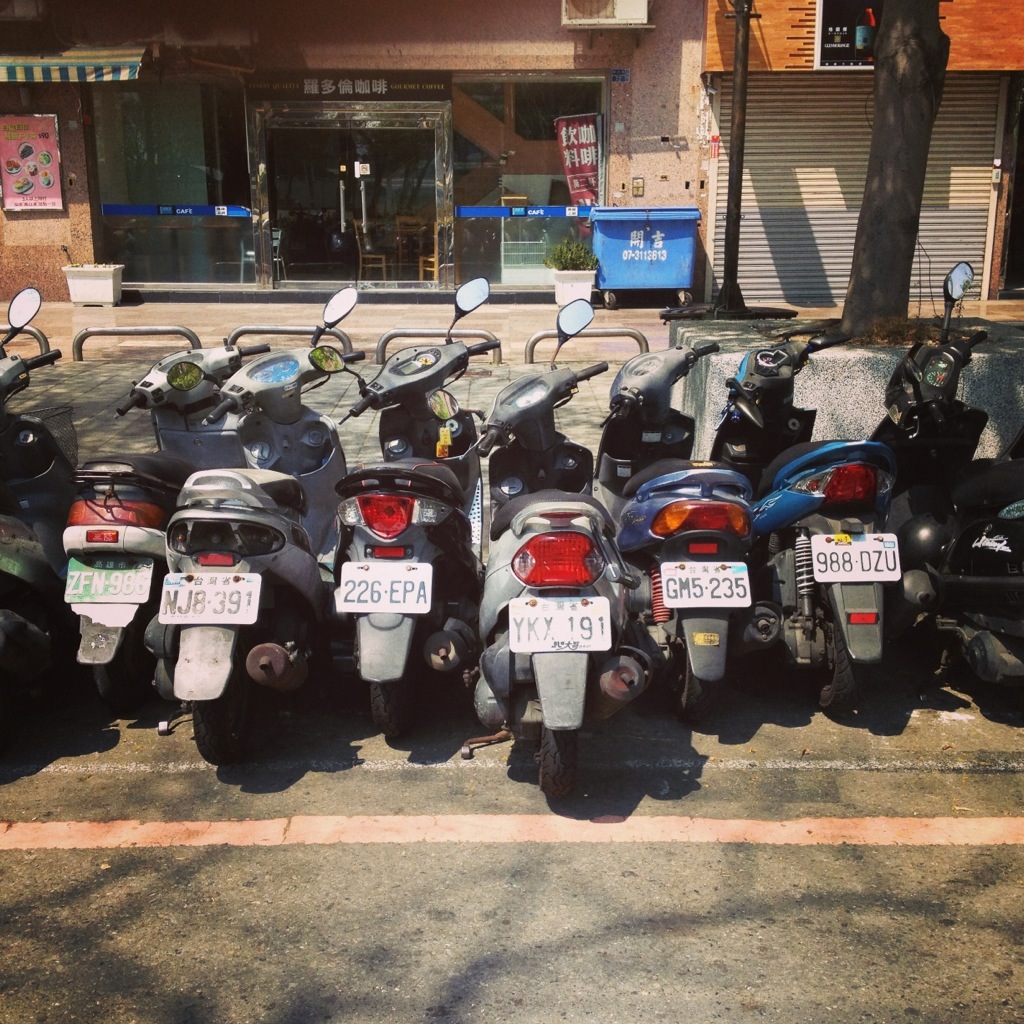
It’s estimated there are more than 15 million scooters in Taiwan (Google it) and one needs only to walk down the street  to realize that finding parking for them can be damn near impossible.

A friend of ours recently offered to loan us a scooter (to help me out with my recent job search and because he had nowhere to put it) and we happily accepted, promising not to destroy it. The first night it was in our possession it was towed from in front of our apartment building. We figured it would be fine parked next to a row of other scooters, but were mistaken and shelled out NT $800  (about $27) for a lesson learned.

Hoping to avoid being towed in the future, I decided to enlist the help of my iPhone to compile a short list of tips for choosing a place to stash the ride.

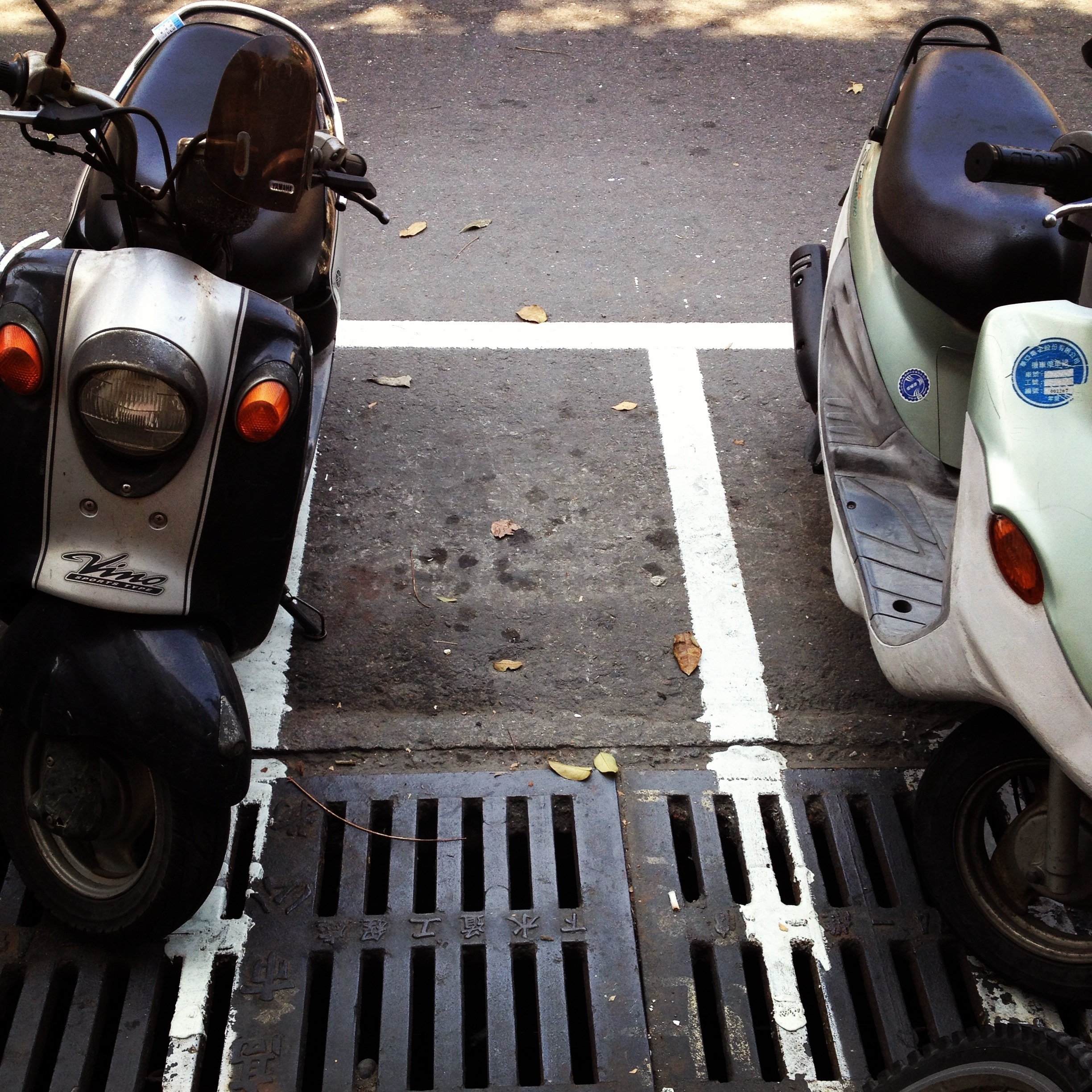
#1. White lines are your friend

As a general rule, when you see parking slots painted white, you’re in the clear to park. In busier areas you might have to pay a small fee for these spots, usually via a small ticket that a meter maid attaches to your ride. Pop into the nearest 711 to pay it.

20130311-133827.jpg

Keep in mind that actually finding an open white slot can be easier said than done.

20130311-144014.jpg

#2. Sidewalks are for walking, except when they’re for parking.

This is a parking grey area. Technically it’s not legal to park on the sidewalk, but if it’s directly outside outside a business (in this case, a casino) whose patrons have claimed the sidewalk for parking, give it a go, but try to get a spot in the middle of the pack to give you a buffer in case the tow fellas show up. Parking on the sidewalk during the day for short period of time is generally acceptable, but leave it over night and there’s a good chance it’ll end up at the impound lot.

20130311-145340.jpg

#3. Be mindful of the yellow “X.”

The yellow “X” is a certified no parking zone. You usually see them in the lone space where one can access the sidewalk to enter a building. This one has the advantage of side-rails for added parking deterrence.

20130311-230736.jpg

But every rule has an exceptional asshole who is above it.

20130311-231652.jpg

#4. A little wiggle room is helpful.

Don’t be afraid to move the scooters around you for added space. I assure you no one will think twice about moving yours. I’ve come downstairs many times to find that some prick has taken my scooter off the prop-stand a put it on the leaning kickstand so they could squeeze their ride in, scratching my muffler to hell in the process.

20130311-233041.jpg

Teamwork is sometimes required to achieve the perfect fit.

20130311-234111.jpg

#5. When all else fails, stand guard and wait for something to open up.

Why make loops around the block when you can wait and enjoy the finer things in life?

20130311-234940.jpg

Have parking tips of your own? Drop them in the comments section. Find me on Instagram @jaywoodson.

TADIT Fights for Diversity and Fairness in Taiwan

Screen Shot 2013-03-05 at 1.22.52 AM

The Taipei Times recently published a story about a group of foreign English teachers who have  launched an effort to combat discrimination in Taiwan’s ESL market. The group–Teachers Against Discrimination in Taiwan(TADIT)–was started by Annie Chen, a Taiwanese American with dual citizenship who had trouble finding work as an English teacher in Taipei because of her Asian appearance and last name. Her experience echoes that of many other non-white English teachers who have come to Taiwan eager to teach.

I remember sifting through hundreds of threads on Forumosa and Tealit before I left the states that mentioned the discriminatory (and in some cases, racist) attitudes of English cram school operators and Taiwanese citizens. When I arrived almost all the expats I spoke with told me that I would have a harder time finding work due to my skin color. It’s not that I took it in stride per se, but I wasn’t going to let it deter me from from trying. I’d survived living and working in Korea–perhaps one of the most xenophobic nations in Asia–so I didn’t think Taiwan would present me with anything I couldn’t handle. Or so I thought.

For me, reading about TADIT could not have come at a better time.

Last Monday I was called into a school that I had sent a cold email to the previous week. They were in need of a part-time teacher and I was invited to come in for a demo and interview. I arrive to the same surprised expression I’ve been getting when walking into schools; the “oh shit, he’s black” look. No problem. I smile and inform them I’m there for a scheduled lesson demo and interview. I expected to do the demo in front of an actual class, but instead had to do it for one of the managers and a Taiwanese teacher. It doesn’t bother me at all and I feeling like I nailed it. A quick vocabulary activity, some simple sentence structure and I’m done. As I’m leaving the manager tells me that when I come back she’ll show me how to use the special interactive white board. Her choice of the word “when” has me feeling like I got the job.

The next day that same manager gives me a call and explains that there is a “small problem.” I need to come back for another demo–this time for the director of the school and a different manager– because they’ve never had a teacher who was black. The explanation leaves me offended and a conflicted about rather to return for the demo. I contemplate going in and giving a lesson on the importance of diversity in leaning environment instead of anything from the textbooks. During my second demo I’m made to feel as if they were now looking for reasons to not  hire me. The director leaves after only a few minutes and I keep being interrupted with requests to demonstrate how I would teach some minute detail of a lesson I had all but five minutes to prepare. This time when I leave I’m told they will all me if they need anything else. The “if” left no question as to rather I’d be hired or not.

I didn’t plan on sharing this story via Dreadlock Travels, but after reading about Chen and others efforts to fight this type of behavior I felt I needed to share it. Everyone seems to be aware that this is happening, yet until now no one has taken the effort to do anything about it, possibly because of the assumption that nothing can be done.

According to Taiwan law it’s illegal to for schools to discriminate on the basis of race class, religion, etc–something I didn’t know until this morning.

The face of the English speaking world is a muti-ethnic one and I applaud TADIT for understanding that this is not just an employment issue to be fought in schools and courtrooms. There’s also lot to be done in changing a social psyche that perpetuates the myth that a proper English education can only be attained from someone who is caucasian. Schools become reluctant to hire people of color because they’re afraid parents will pull their kids out. No students, no profit.

TADIT has set up a blog and Facebook group urging teachers who have been discriminated against in Taiwan to share their stories. They also have projects in the works that include lobbying politicians and media outlets, as well as hosting a Diversity Day event to show the many cultures of English speaking foreigners.

From the Taipei Times article:

“We think this fear of non-white English teachers comes from a lack of exposure. If we can expose people, especially families, to greater diversity, we can help change things,“ added Hales, who is organizing a soccer tournament, face-painting, live music, yoga classes and an Aboriginal dance performance to feature in the event.

TADIT is also seeking to garner close ties with schools by creating a brochure to encourage them to become equal opportunity employers and there is talk of working with schools to give presentations on diversity awareness to students. All of these projects require help from volunteers. The group is based in Taipei, but the problem is island wide. I encourage anyone who teaching in Taiwan who wants to help to join the Facebook group and help spread awareness. I’m of the mind that this common practice can be stamped out. Chen and her TADIT organization have already taken the first step.

Big shout-out to Byran Harris and the Taipei Times for the feature article on TADIT.

Peace.

Bang Bang–(Surviving)The Yanshui Fireworks Festival

DSC_1139

It’s Saturday night and we have our friends Simon and Tina over for dinner. In between bites of tacos we’re discusing our plans for the rest of the weekend. I have to turn down Simon’s invitation to a pick-up game of ultimate frisbee on Sunday because Kay and I have made tentative plans with some other friends to visit a town north of Kaohsiung in search of a fireworks festival. Tina says she’s been to the festival before, but that she probably doesn’t need to do it again. She also tells us that if we go we’ll need to wear motocycle helmets.

“What for?” I ask. I’d heard very little about the festival and was putting off doing a web search until I knew for sure that we were going, but  certainly didn’t anticipate needing a helmet to attend.

“For protection against the fireworks,” says Tina.

Now I’m confused and thinking about all my previous firework  experiences: numerous Fourth of July celebrations, carnivals, the Minnesota State Fair, the Busan International Fireworks Festival in Korea. I don’t recall needing protective head gear for any of them.

Maybe the Taiwanese have different, more sinister versions of fireworks than what I’m used to. Maybe the festival is a town-wide Roaming Candle war pitting visitors and tourist against the locals. Maybe “fireworks” is an incorrect English translation and the meaning is closer to “gunpowder” or “dynamite.” Who wouldn’t want to visit a Taiwanese dynamite festival?

The next day I do a quick web search and discover that every year on the 15th day after Chinese New Year visitors flock to the town of Yanshui to be repeatedly shot by hundreds of bottle rockets.

The Yanshui Fireworks Festival (widely considered to be one of the most dangerous festivals in the world) stems from a cholera outnreak  in the late 19th century that nearly wiped the small town out. The citizens of Yanshui called upon the Chinese god of war, Guan Dong (also called Guan Di) to help fight the the disease by carrying his statue around town on a palanquin while shooting off  fireworks every step of the way. The epidemic receded and the locals have been paying homage ever since by annually reenacting the pyrotechnic exorcism.

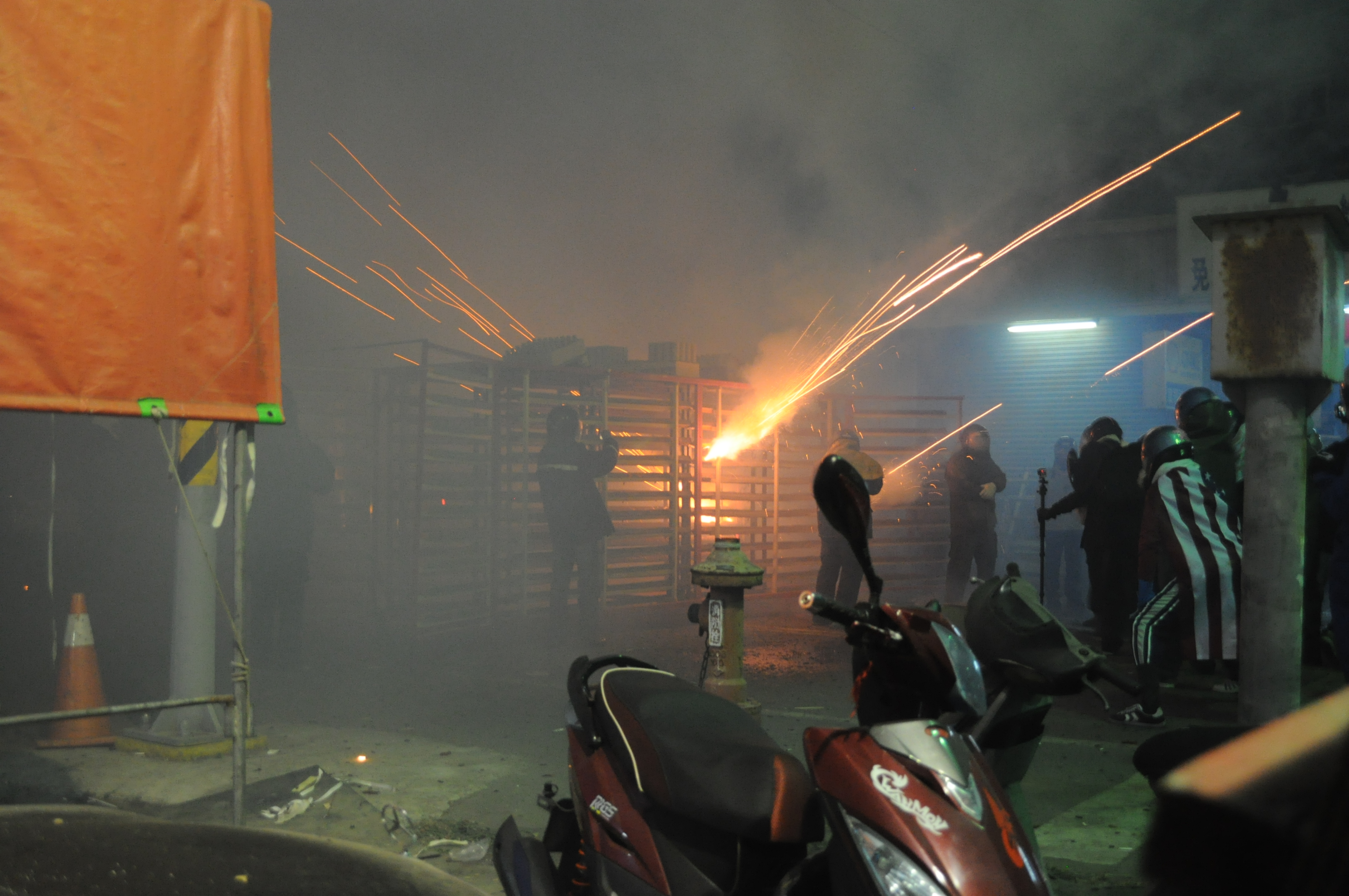
The highlight of the festival revolves around the sporadic lighting of “beehives” –large structures built with wood or steel, laden with thousands of bottle rockets connected to a single intertwined fuse. Once lit, rockets fire in all directions and festival goers donned in motorcycle helmets and coveralls gather around and allow themselves to be pelted.

Positioning the beehive.

Positioning the beehive.

Kay and I decide to visit the festival with some friends, but opt out of being bombarded with fireworks. In fact, of the four people in our group only our friend Jenna (author of the blog Nomad Notions) is brave enough to join the rocket fodder. We hop a train to Tainan City then continue by taxi to Yanshui. We don’t make it more than 5 feet out the car before  hearing the rumble of fireworks in the distance.

The streets are lined with food vendors and local shops have tables set up with scooter helmets, gloves, safety glasses and other rocket protection gear for sale. the air smells like rotten eggs and the entire town is under a heavy blanket of smoke. Dim pulsating lights can be seen flickering through the smoke overhead and groups of people wearing matching coveralls with burn stains are roaming around–no doubt in search of the next beehive explosion.

DSC_1174

We stroll towards the center of town stopping sporadically to sample street food and buy beer. There’s not a lot to do for those uninterested in pyromania, but families still gather for photo ops near a creek littered with glowing ornaments of different sizes, and to send  the occasional prayer lantern floating into the sky. It’s been about two hours since we arrived and we still have yet to witness the lighting of a beehive. We’d gotten word that a large one was set to go off at 10pm, but when that was pushed to 11 (and later, 11:30) we followed others who claimed to have knowledge of one being lit a few blocks away.

Anticipation mounts as the large contraption is rolled into the middle of the street and a fellow who’d clearly been chewing betel-nut all night encourages all the foreigners who want to get blasted by the bottle rockets to be doused with water beforehand to avoid their clothes catching fire. As with many small towns in Asia, the large group of foreigners draw a lot of attention and many of the locals are taking pictures with several expats who have added themes to their protective gear (big shout-out to Captain America).

Waiting for the Beehive to be lit.

Waiting for the Beehive to be lit.

DSC_1089

Participants have water sprayed on them to avoid catching fire.

I snap as many photos as I can then retreat to what Kay and I think is a safe  distance–20-30 yards from the beehive, behind a parked car. They parade the palanquin of Guan Dong around the premises and the crowd quiets as the fuse is lit.

When it starts the first few shoot straight up into the air and rain down sparks onto the entire scene. Then row after row of the rockets fire directly into the crowd, causing those in the front to dance and turn away in an attempt to dampen the force of the barrage. As the fuse travels through the frame the smoke thickens and only long streaks of light left in the wake of the rockets are clearly noticeable. None of them have shot in our direction yet so I rise from the hiding spot (fully exposing my head) to take some photos. By now everyone close to the beehive is hopping around trying to cover the more sensitive areas of their bodies and the entire street looks like an astronaut rave in the middle of a meteor shower.

I whip out my iPhone and begin recording video hoping not to catch a bottle rocket to the face, and a Taiwanese gentleman appears at my side gesturing for me to follow him to a better vantage point. I crouch down and scurry behind him, feeling like a solider scrambling into a foxhole for cover. As he ushers me into a nearby tent (turns out it’s the same tent where they were storing the beehive) two rockets go off near my head and I give up on the recording. I’m way too close. 

 Luckily I end up next to a couple who have gotten ahold of some cardboard and together we hunker down behind it.  After a few minutes the barrage of rockets shifts to a different direction and I’m able to make my way back to the previous shelter behind the car. It’s been ten minutes since they lit the damn thing and it’s still going strong. Some people emerge from the crowd to take a breather and bat out the flames on their clothes before retuning to the onslaught.

When it’s finally over we emerge from our shelter and search for Jenna and some other friends to inspect for injuries. There’s a few burn holes and a mangled umbrella, but no one is hurt and everyone is wearing a wide grin. Beers are drank and we take some time to enjoy the fireworks that are being shot overhead instead of into the crowd.

DSC_1160

Captain America took one for the team.

We watch a couple more beehives explode (one made to look like Sponge Bob and the other shaped like a tea pot) before calling it a night and heading back to Kaohsiung. It’s 1 a.m. but some people are just arriving as the festivities will continue until 4. I’m secure in my decision not to join in on the action, but pledge to partake next year. It’ll be two hours before we make it back home–plenty of time for my ears to stop ringing.

Peace

*Author’s note: If you’d like to read about Jenna’s recount of her experiences on the front lines, you can do so here.

The Search Continues

The last few weeks have brought about a lot of change. Kay and I were able to move out of our temporary housing into a spacious two-bedroom apartment that we both enjoy, we were able to set up internet service (though it wasn’t installed until after Chinese New Year) and we survived copious amounts of time spent at Ikea Carrefore, and the ever helpful Daiso (Japan’s take on the dollar store).

Life in Kaohsiung is slowly creeping toward normalcy except for–despite my sincerest efforts–I haven’t been able to find a teaching gig.

I was more than happy to suspend my job hunt during Chinese New Year. All  schools closed up so that employees could enjoy the holiday and join the hoards of Taiwanese traveling around the island and crowding every shopping mall, movie theater and any other public space to celebrate the year of the snake. Besides taking a break from canvasing the city for job leads, I took advantage of the CNY sales. A family pack of toilet paper was going for less than two bucks.

But now that the holiday is over I’ve returned to my daily routine of searching expat forums and cold-emailing potential schools hoping to find one that is in need of a teacher. I’m kicking myself (a little) because a school that I previously did a lesson demo for called me back; not to offer me a job, but to allow me to provide a second hour-long demo. I turned the “opportunity” down mainly because the atmosphere seemed frantic, with teachers scrambling to prepare for their lessons in between sips of tea. Also there’s a good chance that most of my hours would have fell on a Saturday with the rest being scattered throughout the week. I’m not against working on Saturdays, but a six-day work week isn’t for me.

Other potential job leads include a single conversation before the holiday with a recruiter from one of the bigger chain schools. She sounded confident that she could help me out after Chinese New Year and told me she would email some info regarding the position, but I have yet to hear back from her and all my efforts to contact her have been unsuccessful. I’m beginning to think I’m annoying her somehow. I’ve also walked into schools and handed them my resume with a smile. Maybe there’s a postion about that’s about to open up; if so I’d like to be considered for it. Today I called a school that I recently left a resume at and the manager couldn’t remember if she took a look at it or not. She took my number and promised to get back to me.

Some teachers I’ve talked to have claimed my lack of success with landing a job is because I’m black (one woman all but told me to give up) and employers are nervous about hiring people of color because they don’t want to agitate parents who would rather see their kids taught but someone with less melanin. I did some research on this before I came to Taiwan and found that while it may be true that some cram schools are partial to non-whites, there are still plenty of blacks from all over the English speaking world teaching in Taiwan and enjoying it. I’d be taking the defeatist approach if I were let this deter me from seeking employment at any school, rather it be a small mom-&-pop Buxiban or one of the bigger chain schools.

With frustration mounting, I’m curious as to how others–either here in Kaohsiung or elsewhere in Taiwan–have gone about finding gigs. Subbing is fine to gain some quick cash, but it doesn’t provide an ARC and making visa runs every few months is not a habit I’m looking to get into. I understand the time of  year matters a lot and that lately there are more teachers than jobs available, but I’d still like to hear how those currently employed went about finding their teaching job, particularly when they first arrived. The tips could prove helpful to other newbies like myself.

Peace

Anthony Bourdain VS Eddie Huang: Taipei

I recently watched the Taipei episode of Anthony Bourdain’s “The Layover” (big thanks to Thinking About Languages for the heads up). To be honest this was the first episode I’ve seen since the show first aired in November of 2011. I’m a die-hard junkie of “No Reservations,” often times watching it to scout for future travel destinations. I didn’t enjoy everything that Bourdain and his producers chose to highlight (the dancing and guns segment in Greece was a little odd), but they did a solid job of showcasing the glamorous and gritty of different countries.

The premise of “The Layover” is different from “No Reservations” in that Bourdain only spends 48 hours in each location, mainly focusing on the must-see, must-do and must-eat.  We still have the normal bleeping-out of Bourdain’s colorful language  and a solid mixture of destination insiders to consult, but the clock is always ticking. It’s not a format I would personally ascribe to for visiting anywhere, but it works for the purposes of television.

That being said, I couldn’t resist comparing Bourdain’s view of Taipei to that of Eddie Huang, the badboy chef/hipster host of Vice Magazine’s ‘Fresh Off the Boat.’ Here, the Taiwanese American raised in Orlando but based in New York, along with his crew, strive to “venture into subculture through the lens of food”  (though the food part sometimes takes a backseat to other subjects). Since the show’s release (via YouTube) last October Huang has shown us some of the lesser known angles of his destinations (he goes hunting for rabbits in Oakland), utilizing an eclectic cast of chaperones and a heavy dose of east coast slang. It’s not the type of stuff you’d find on the Travel Channel, but that’s not surprising given Vice’s reputation pushing the envelope.

Coincidentally, the last segment of “Fresh Off the Boat: Taiwan” was released a week after ‘The Layover’ and naturally I thought the two hosts would present us with different but equally important views of the island. After watching however, I was surprised at how similar the two episodes were. Normally Chef Huang has a penchant for slamming other celebrity chefs.  

Both Huang and Bourdain do a good job of talking about the different foods they sample and Huang in particular seems to dim his east coast bravado when doing so, taking great care to explain the different flavors and textures. They both stroll throug night markets stopping periodically to showcase a specific item; Bourdain quickly gobbles down a pork belly gua bao (steamed bun sandwich) at the Keelung night market and Huang pauses to joke about penis shaped waffles at the night market in Shilin.

The two hosts also visit the 24-hour shrimp fishing restaurant, Cheun Chang as well as a place where western and Taiwanese fare is served in different types of miniature toilets. Neither of them seem to enjoy either experience which makes me think the shrimp fishing and toilet food segments were included only for their novelty.

I could see why both hosts decided to include a trip to Din Tai Fong. Bourdain and Huang rave about how good the restaurant’s soup dumplings are, and the process of how they’re made is worth showcasing. I’ve never been there personally, but I’m inclined to seek the place out next time I’m in Taipei. (If there’s a Din Tai Fong chain in Kaohsiung let me know and the first round of dumplings is on me.)

Given all the similarities between “Fresh Off the Boat: Taiwan” and “The Layover: Taipei” there’s still enough differences to warrant taking in both. Bourdain has a drink or two during his time in Taipei, but Huang goes for the gusto and picks up some betelnut, a popular Asian stimulant that is chewed–similar to chewing tobacco. Huang (who speaks fluent Chinese) is able to mix it with locals without a translator and is thus easily able to tackle the sticky subject of Taiwanese independence, while Bourdain focuses keeps it pithy with conversations about strippers at Taiwanese funerals and an odd form of martial arts. The aims of “The Layover” involve giving a short-term visitor an idea of what to see on a visit, but “Fresh Off the Boat” attempts (with varied success) to unearth the layers of culture often unseen by tourists. Fair enough.

I haven’t been here long enough to decipher which account of Taiwan is more encapsulating, but I’d love to hear feedback from anybody who has.

Fresh Off the Boat has two episodes in Taiwan, broken up into six parts. Find part one as well as The Layover: Taipei below.

Peace.

Job Search and Lesson Demos

hireme

For most of the last week my routine has been the same: wake up, check my email for replies to job queries, scroll through a few expat forums for new job postings, take off for an interview, return home, check the forums again. It’s a painfully mind numbing  yet necessary process. I’m here to teach, but first I must find a job.

From what I can tell the job search process is broken up into three parts: resume submission, interview and lesson demonstration. Depending on where you apply, all of these could happen on the same day or across several. There’s really nothing to the interviews as most schools just want to verify the info on your resume and make sure that you’re A: relatively sane and look presentable, and B: able to commit to a one- year contract–pretty standard stuff.

The tricky part (for me, at least) is the lesson demo. This is where they hand you lesson (or a blank sheet of paper), give you some prep time (anywhere from five minutes to several days) and push you into a classroom. The idea is to see how you interact with the students and to get a feel for your teaching style, with the possible added benefit of seeing you freak out and collapse under pressure.

Luckily I was able to line-up two demos this week. The first is at a small Buxiban (private school) catering to elementary schoolers, and the other at a large chain school with several branches across the city.

I show up at the first school and am greeted by the foreign director of the school; a tall middle-aged American whose hair reminds me of a less red, slightly silver version of Conan O’Brien’s. The small lobby contains a few tables with kids doing homework and teachers are milling about sorting through folders and talking with the kids at the tables.  The entire school is no bigger than most of the Mom & Pop stores around Kaohsiung and I almost clothes-line a passing student as I extend my arm to shake hands with the director.

After a solid interview I’m handed a lesson book and told that I’ll need to demo a review lesson for 15 about minutes. I look over the curriculum and jot down a simple lesson plan before walking into a tiny classroom of  smiling third graders. They all let out a collective “whoooa” when I walk in and I take a few minuts to tell them my name and show them on the map where I’m from. My lesson plan is to hit them with review drills in which they can gain points for correct answers, make a few self-deprecating jokes and knock out a quick song from the lesson book; simple, direct and proven.

The plan goes over well.

I’m able to get all the kids to participate, they chuckle at my jokes and no one notices that I lip-sang more than half of the song at the end of the lesson. I like the vibe I get from the staff and the laid back approach to the curriculum. The director tells me he’ll let me know by Monday and I leave feeling good about my chances of getting the job. Moreover I’m feeling like my next demo across town will be equally successful.

When I arrive, I’m shown into an office where several teacher’s are hastily preparing for the evening’s lessons. Packets of books are being tossed into boxes, copies are being made, student rosters are being discussed.  Someone comes in to announce that dinner and tea orders need to be placed with the secretary immediately. The wall behind is lined with staff lockers and several shelves containing an array of folders and giant flash cards sorted under ‘Transportation’, ‘Foods’ and many other phonics categories. I’m introduced to a handful of teachers who barely look up from what they’re doing.

The manager of the school (also the person who interviewed me a couple days ago) hands me a book and tells me that I’ll be teaching Lesson 19 for my demo. “Let me know if you need to use the copy machine,” he says.

Copy machine? What do I need to copy?

I flip open the book and give the material a quick once over. The details about my demo are (purposely) vague so I begin sketching a lesson plan relying once again on old strategies I learned teaching in Korea. I don’t know what age group I’ll be working with, but judging from the material I assume they’re slightly older than the third graders I had earlier. Like the last demo. I’ll need to include some review of previous material, but this time I’ll be teaching for an hour instead of 15 minutes.

Along with the review I plan a couple of listen-and-repeat activities and two simple games for added excitement. Before heading into the classroom I’m asked if there are any other materials that I’d like to bring in with me. I quickly grab a toy hammer and declare myself ready.

I stagger through the first part of the lesson and play the wrong CD track during the listening exercise, but still manage to retain my confidence. The students (mostly fifth graders) are receptive to my lesson but don’t show any signs of excitement until the word recognition game towards the end, which my observer fails to observe because he leaves to go administer a test. So the best part of my demo goes largely unnoticed.

The hour goes by fast and I return to the teacher’s office to talk about how the lesson went. An hour goes by before the manager shows up and he looks surprised to see me still there. He thanks me for waiting but tells me that he unfortunately has to go administer another test and that it will be another hour before he’s finished if I want to wait for feedback. I get an email from him later that night telling me that due to a busy upcoming weekend, he won’t have time to discuss my demo until sometime Monday evening.

On the subway ride home I consider which of the two schools I’d  rather work at: the smaller operation with miniature classrooms, or the bustling chain school that wants me to wait several days for lesson feedback.

Meanwhile, the search continues.

Jay